AI Startup Go-To-Market Strategy: How to Use AI, Funnels, and Smart Marketing to Win Early Customers
Key Takeaways
AI startups do not need more random marketing activity. They need a go-to-market strategy tied to a real customer problem.
AI can speed up research, positioning, content, outbound, funnel testing, onboarding, and customer feedback loops.
The best AI startup marketing does not lead with “Look, we use AI.” It leads with the painful problem the buyer wants solved.
A strong GTM plan connects audience, offer, messaging, channels, funnel, sales motion, proof, and retention.
To rank on Google and show up in AI-generated answers, AI startups need helpful, specific, experience-backed content with clear entities, citations, internal links, and original insight.
AI Startups Do Not Have a Marketing Problem. They Have a Clarity Problem.
AI startups are everywhere right now.
AI copilots.
AI agents.
AI workflow tools.
AI SDRs.
AI note takers.
AI design assistants.
AI analytics platforms.
AI customer support bots.
AI tools that promise to save your team 10 hours a week, make your coffee, walk your dog, and finally explain what your CRM is actually doing.
It is exciting.
It is also noisy as hell.
That is the problem.
Most AI startups are not competing against one company.
They are competing against confusion.
Your buyer is not sitting around thinking:
“Wow, I sure hope another AI startup enters my inbox today.”
They are thinking:
“I have a painful business problem, too many tools, not enough time, and I do not want to buy another shiny platform that becomes shelfware by Thursday.”
That is where your AI startup go-to-market strategy matters.
Not your logo.
Not your launch post.
Not your 97-slide investor deck with a hockey-stick chart that looks like it was drawn during a caffeine emergency.
Your GTM strategy is the path from:
“Nobody knows who we are”
to:
“The right buyers understand us, trust us, try us, and stick around.”
That path needs strategy.
And yes, AI can help.
But AI cannot rescue weak positioning, lazy messaging, or a funnel that feels like IKEA furniture instructions after three margaritas.
Google’s guidance on AI-generated content is also pretty clear: AI content is not automatically bad, but content created mainly to manipulate rankings instead of helping people is a problem. The goal is helpful, reliable, people-first content. (developers.google.com)
So if your startup’s content strategy is “publish 80 AI-written blog posts and pray,” congratulations.
You have invented SEO confetti.
Fun to throw.
Terrible business model.
The better move?
Use AI to build a sharper, faster, more useful go-to-market system.
That is what this article is about.
What Is a Go-To-Market Strategy for an AI Startup?
A go-to-market strategy for an AI startup is the plan for how you will reach the right market, explain your value, create demand, convert buyers, and keep customers long enough to grow.
Simple definition.
Hard execution.
A strong GTM strategy answers:
Who are we selling to?
What painful problem do we solve?
Why do buyers care now?
What makes us different?
What proof do we have?
What channels will we use?
What funnel will move buyers from awareness to action?
What sales motion fits our buyer?
What content builds trust?
What onboarding experience creates a quick win?
What metrics tell us whether this is working?
For AI startups, this is especially important because the category is crowded.
You are not just explaining your product.
You are explaining why your product should exist.
That is a different boss fight.
A normal SaaS startup might say:
“We help teams manage projects.”
An AI startup might say:
“Our AI agent autonomously orchestrates cross-functional project workflows using predictive task prioritization and adaptive knowledge retrieval.”
And the buyer says:
“Cool. So… is this another task app?”
That is the gap.
Your job is not to sound smarter.
Your job is to make the buyer feel less confused.
Hardy Marketing’s voice context says it well: information is cheap, but guidance is valuable. The best brands simplify the buying journey, reduce confusion, and guide people toward the right decision.
That is the entire GTM game for AI startups.
Do not make people decode your brilliance.
Translate it.
The Biggest GTM Mistake AI Startups Make: Selling the Tech Instead of the Outcome
Here is where many AI startups trip over their own cape.
They lead with the model.
The automation.
The agent.
The architecture.
The technical magic.
The “proprietary retrieval-augmented multi-agent workflow layer,” which sounds impressive until your buyer’s eyes quietly leave their body.
Most buyers do not care that your product uses AI.
They care what your product helps them do.
Save time.
Reduce cost.
Book more calls.
Improve customer support.
Shorten sales cycles.
Catch errors.
Generate reports.
Find insights.
Launch campaigns faster.
Make better decisions.
Get home before their kid’s soccer game.
That last one sells more software than people admit.
The AI is the engine.
The outcome is the car.
Do not sell the engine first unless your buyer is a mechanic.
This matters even more because AI adoption is broadening across business functions. McKinsey’s 2025 State of AI research says marketing and sales remain among the functions where organizations most often report AI use, and revenue increases from AI are most commonly reported in marketing and sales, strategy and corporate finance, and product/service development. (mckinsey.com)
Translation?
Your buyers are already hearing about AI.
They are already testing AI.
They are already tired of vague AI claims.
So your GTM messaging needs to get specific.
Bad message:
“We help companies unlock AI-powered productivity.”
Better message:
“We help B2B sales teams turn messy call notes into CRM-ready follow-up tasks in under 60 seconds.”
See the difference?
One is corporate oatmeal.
The other is a problem, a buyer, a use case, and a result.
That is how AI startups should think about positioning.
Specific beats impressive.
Clear beats clever.
Outcome beats architecture.
Every time.
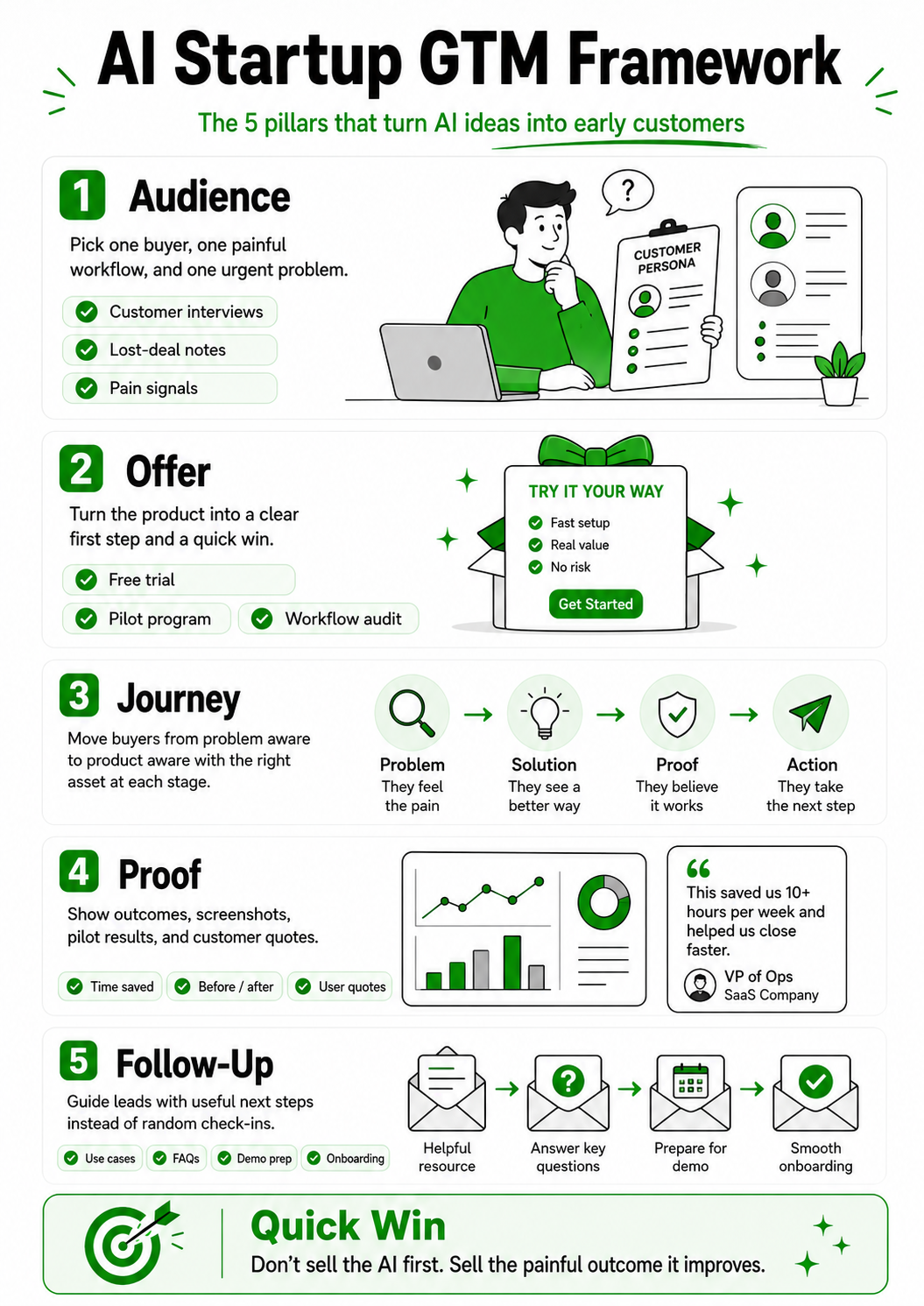
The Hardy Marketing GTM Framework for AI Startups
Let’s make this practical.
Here is a simple framework AI startups can use to build a go-to-market strategy without disappearing into a Notion dungeon for six weeks.
Audience
Start with the buyer.
Not the product.
Not the feature.
Not the demo you built because your CTO thought it was cool at 1:13 a.m.
Who has the painful problem?
Be specific.
Not:
“Marketing teams.”
Better:
“B2B SaaS marketing teams with 5–20 people that publish content weekly but struggle to turn organic traffic into qualified demo requests.”
Not:
“Healthcare companies.”
Better:
“Multi-location clinics that need faster patient intake, better follow-up, and fewer missed appointments.”
Not:
“Sales teams.”
Better:
“Outbound sales teams whose reps spend too much time writing manual follow-up after discovery calls.”
AI can help here.
Use it to analyze:
Sales calls
Customer interviews
Support tickets
LinkedIn comments
Reddit threads
Reviews
Competitor pages
Demo notes
CRM lost-deal reasons
Founder conversations
Ask AI to find repeated pains, urgent language, objections, buying triggers, and emotional tension.
But do not let AI invent your customer.
Use AI to organize reality.
Not replace it.
Offer
Next, clarify the offer.
Most AI startups do not have an offer.
They have a product description wearing a fake mustache.
An offer needs to answer:
What do I get?
What does it help me do?
How fast can I see value?
What makes it easier to say yes?
What proof do you have?
What happens next?
For early-stage AI startups, your offer may be:
Free trial
Freemium product
Founder-led demo
Pilot program
Paid beta
Done-with-you onboarding
ROI assessment
Workflow audit
Internal champion kit
Migration support
Do not assume “book a demo” is enough.
For many AI products, buyers need a smaller first step because the product feels new, risky, or hard to understand.
Create a quick win.
That might be:
“Upload one sales call and get a follow-up brief.”
“Run one campaign through our AI scoring tool.”
“Analyze one workflow and find your biggest automation opportunity.”
“Generate one customer support automation map.”
“Audit one landing page with AI and get five conversion fixes.”
That is better than asking cold traffic to marry you after one coffee.
Journey
Your GTM strategy needs a buyer journey.
Not random assets floating around like space junk.
For AI startups, a useful journey often looks like this:
StageBuyer QuestionGTM AssetProblem aware“Why is this process so slow?”Educational article, LinkedIn post, diagnostic checklistSolution aware“Can AI help fix this?”Use case guide, explainer video, workflow teardownProduct aware“Why this tool?”Comparison page, demo, case study, ROI pageEvaluation“Will this work for my team?”Pilot offer, security page, onboarding plan, FAQAdoption“How do we get value fast?”Quick-start guide, templates, success planExpansion“Where else can we use this?”Use case library, quarterly review, playbooks
This is where AI startups can borrow from funnel strategy.
Every asset should move the buyer one step closer.
If your content does not help the buyer make a decision, it is just digital confetti.
Pretty.
Pointless.
Proof
Proof matters more for AI startups because buyers are skeptical.
And honestly, fair.
They have seen too many demos where the AI performs like Tony Stark on stage and then like a confused Roomba in production.
Build proof early.
Use:
Before/after screenshots
Workflow demos
Time saved
Tasks completed
User quotes
Pilot results
Case studies
Security documentation
Founder expertise
Benchmarks
Demo videos
Transparent limitations
Do not say:
“Our AI saves teams time.”
Say:
“In a 14-day pilot, one three-person ops team reduced manual reporting time from five hours per week to 90 minutes.”
Specific proof beats vague hype.
Always.
Follow-Up
Most AI startup leads will not convert immediately.
They need education.
They need internal buy-in.
They need to understand risk.
They need to believe your product will not become another tool nobody uses.
That means your follow-up needs to do more than say:
“Just bumping this to the top of your inbox.”
No.
Delete that sentence from the earth.
Instead, create follow-up based on behavior.
If someone downloads a guide, send them a use case.
If someone visits pricing, send proof and FAQs.
If someone starts a trial, send quick-win setup steps.
If someone books a demo, send a prep email with what they will learn.
If someone stalls after the demo, send an objection-handling sequence.
If someone becomes a customer, send onboarding that gets them to value fast.
That is not “selling harder.”
That is guiding better.
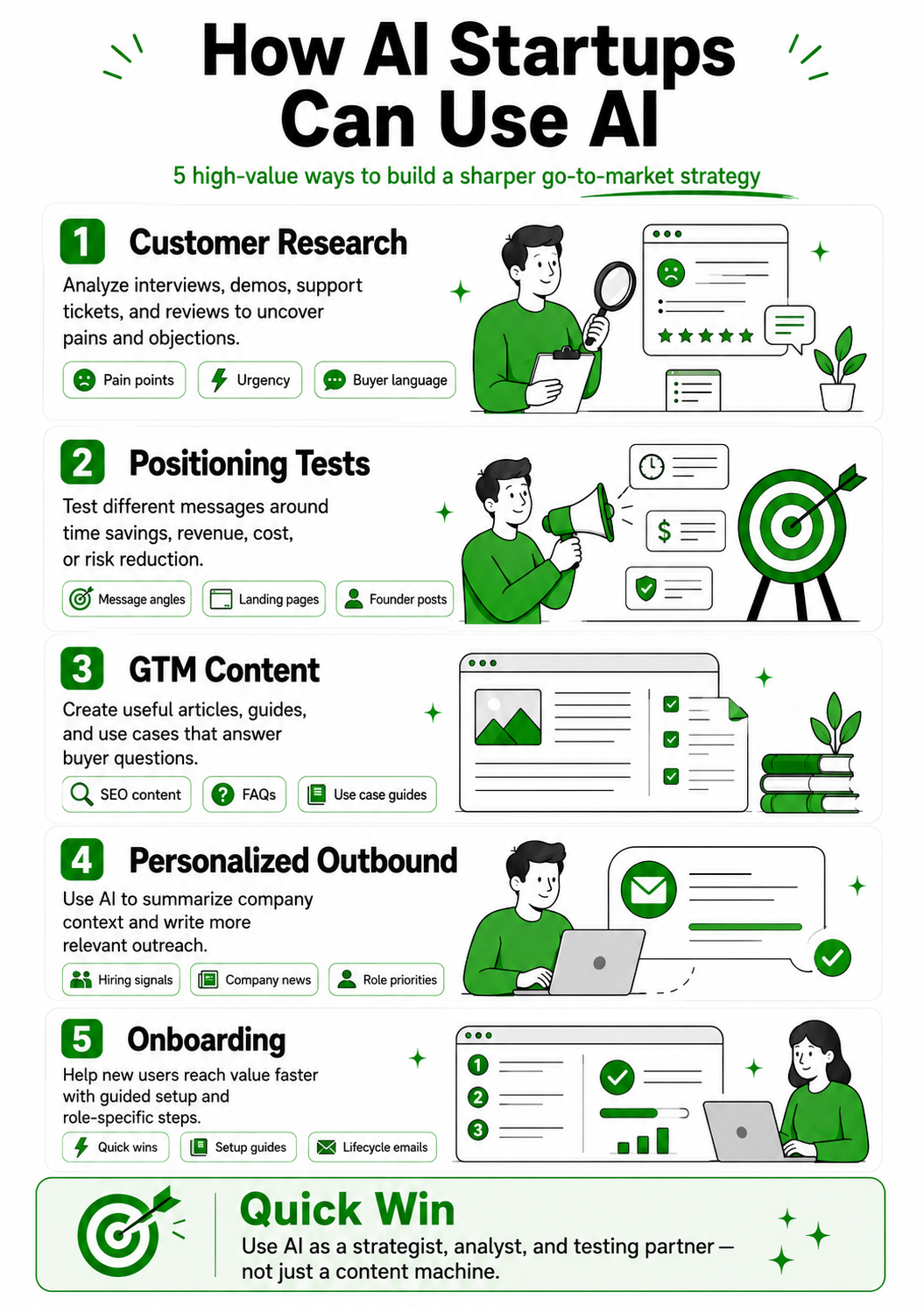
How AI Startups Can Use AI to Build Their GTM Strategy
Now let’s get meta.
AI startups should absolutely use AI to build their own GTM strategy.
That does not mean letting ChatGPT write your entire launch plan while you go make a sandwich.
It means using AI as a research assistant, strategist, analyst, copy partner, and testing engine.
Here are the highest-value use cases.
Use AI for Customer Research
Feed AI real data.
Not vibes.
Give it:
Demo transcripts
Lost-deal notes
Customer interview transcripts
Support tickets
Product usage notes
Reviews from adjacent tools
Competitor testimonials
Sales call summaries
LinkedIn comments
Community discussions
Then ask it to identify:
Pain points
Desired outcomes
Buying triggers
Objections
Confusing language
Feature requests
Trust gaps
Category expectations
“Why now?” moments
Example prompt:
Analyze these customer interview notes. Find the top 10 repeated pains, the exact phrases buyers use, the objections that stop them from buying, and the moments where urgency appears. Group the findings by buyer role.
That is useful.
Asking “Who is my audience?” with no data?
That is how you get made-up personas named Operations Olivia and Startup Steve.
Nobody wants that.
Use AI for Positioning Tests
Your first positioning will probably be wrong.
That is normal.
Marketing is not stone tablets from a mountain.
It is testing.
Use AI to create positioning variations based on different angles:
Time savings
Cost reduction
Revenue growth
Risk reduction
Better decision-making
Team productivity
Compliance
Customer experience
Competitive advantage
Then test them.
Landing pages.
LinkedIn posts.
Outbound emails.
Founder videos.
Demo scripts.
Ad angles.
Your goal is not to find the cleverest message.
Your goal is to find the message buyers repeat back to you.
When prospects say:
“Oh, so this helps my team do X without Y?”
Pay attention.
That is positioning gold.
Use AI to Build GTM Content Faster
AI startups need content.
But not generic “What is AI?” content.
Please, the internet has suffered enough.
You need content that answers buyer questions.
Examples:
“How to choose an AI agent for customer support”
“AI workflow automation for RevOps teams”
“AI sales call summaries: what to automate and what to keep human”
“AI onboarding checklist for B2B SaaS teams”
“How to evaluate AI tools without creating security chaos”
“AI startup pilot program checklist”
“AI implementation mistakes that kill adoption”
This kind of content can rank on Google and appear in AI-generated answers because it is specific, useful, and tied to real search intent.
Google’s current AI Search experience includes AI Overviews and AI Mode, which provide summarized answers with links for users to explore more. That makes clear, structured, source-backed content more important because your content needs to be easy for humans and AI systems to understand. (search.google)
That does not mean writing for robots.
It means writing so clearly that both people and machines can tell what the page is about.
Simple headings.
Specific answers.
Clear examples.
Definitions.
FAQs.
Citations.
Original insights.
Tables.
Internal links.
Proof.
Not keyword soup.
Never keyword soup.
Keyword soup is where good content goes to die.
Use AI to Personalize Outbound
Outbound is not dead.
Lazy outbound is dead.
There is a difference.
AI can help startups personalize outbound without spending 40 minutes researching every prospect like a detective with a caffeine problem.
Use AI to summarize:
Company news
Recent hiring
Tech stack clues
Website messaging
LinkedIn activity
Job posts
Funding announcements
Pain signals
Role-specific priorities
Then write outreach that connects your product to a real business problem.
Bad outbound:
“Hi, I noticed you are a growing company and wanted to connect.”
That sentence should be placed in a museum of crimes.
Better:
“Saw your team is hiring three customer success roles while pushing enterprise onboarding. Usually that means onboarding volume is starting to stretch the team. We help CS teams automate onboarding handoff notes without losing the human context.”
That is specific.
That sounds like someone paid attention.
AI can help you get there faster.
Human judgment makes it not creepy.
Important distinction.
Use AI to Improve Onboarding
For AI startups, onboarding is part of the GTM strategy.
Not a post-sale chore.
If users do not reach value quickly, they churn.
Or worse, they keep paying for three months while quietly resenting you.
Your onboarding should create a quick win.
Use AI to:
Build onboarding checklists
Create role-specific setup guides
Summarize product usage patterns
Identify stuck users
Draft lifecycle emails
Create help content
Generate support macros
Analyze churn reasons
Personalize success plans
McKinsey’s AI workplace report notes that sales and marketing account for a large share of gen AI’s potential economic value, but it also shows many organizations still struggle with ROI and adoption. That means AI startups that help customers actually implement and measure value will have an advantage over startups that just sell the dream. (mckinsey.com)
The product does not win when someone signs up.
The product wins when the customer says:
“Oh. This actually helps.”
That is the moment.
Build your GTM around getting people there faster.
SEO and AI Answer Optimization for AI Startups
Now let’s talk about ranking.
Because if your AI startup wants to be discovered, you need to think beyond traditional SEO.
You still need Google SEO.
But you also need visibility in AI-generated answers.
People are searching differently now. They are not just typing two-word keyword phrases into Google like it is 2012 and they still have an iPod Nano in a drawer somewhere.
They are asking longer questions.
They are comparing tools.
They are researching categories.
They are asking AI systems to summarize options, explain tradeoffs, and recommend next steps.
That means your AI startup go-to-market strategy needs content that can rank in search engines and show up in AI-assisted discovery experiences.
Google’s AI search experiences, including AI Overviews and AI Mode, are designed to give users summarized answers with links for deeper exploration. That makes clear, structured, source-backed content more important than ever because your content needs to be easy for humans and AI systems to understand. (search.google)
This is where AI answer optimization, sometimes called GEO or AEO, matters.
The practical idea is simple:
Make your content easy for AI systems to understand, trust, summarize, and cite.
That does not mean writing for robots.
Please do not do that.
Writing for robots is how you end up with sentences like:
“Our robust ecosystem empowers scalable innovation across verticalized workflows.”
Gross.
That sentence needs to be taken outside and given time to think about what it has done.
Instead, your content should clearly answer the questions your buyers are already asking.
For example, if a founder is researching a go-to-market strategy for AI startups, your article should explain what a GTM strategy is, how it works, what mistakes to avoid, and how to build one step by step.
If a growth lead is searching for an AI startup marketing strategy, your content should connect positioning, demand generation, funnel design, sales enablement, content, onboarding, and retention.
If a founder is looking for an AI GTM strategy, do not bury the useful stuff under buzzwords. Give them the actual path from buyer research to offer creation to channel testing to funnel optimization.
If a B2B founder is researching B2B AI startup marketing, show them how to build trust, create proof, shorten the buying journey, and make complex AI products easier to understand.
That is how you rank.
Not by cramming keywords into one sad paragraph like you are stuffing socks into an overpacked suitcase.
By making the article genuinely useful for the exact searches your buyers are making.
A smart content strategy for AI startups should naturally cover topics like AI startup positioning, AI startup customer acquisition, AI startup funnel strategy, and AI startup launch strategy because those are not just keywords.
They are real business problems.
And real business problems deserve better than SEO sludge.
Google’s helpful content guidance encourages creators to produce original, useful, reliable, people-first content that demonstrates experience and provides value beyond simply summarizing what others have already said. (developers.google.com)
That is the advantage for AI startups willing to go deeper.
Most AI startup content is either:
Too technical
Too vague
Too promotional
Too generic
Too obsessed with the AI
Too light on proof
You can beat that by being specific.
For example, instead of writing another generic post called:
“The Future of AI in Business”
Write something like:
“How B2B AI Startups Can Build a Go-To-Market Funnel That Turns Product Demos Into Qualified Pipeline”
That kind of article is more useful.
It targets real search intent.
It helps the buyer make a decision.
And it gives Google and AI answer engines clearer context about what your company knows.
Your content should also connect naturally to deeper resources. For example, when an AI startup founder is choosing tools to support their GTM motion, Hardy Marketing’s AI Marketing Resource Vault is a natural next step because it helps marketers and founders explore AI tools without wandering into the AI tool black hole and emerging three hours later with 27 tabs, four free trials, and no strategy.
When the article talks about building fast startup landing pages, MVP pages, funnel pages, or product validation pages, it should naturally point readers to Hardy Marketing’s guide on AI website builders and AI funnel builders. That resource fits because AI startups often need quick, clear pages to test positioning, capture demand, and move prospects into a demo or pilot flow.
And when the article discusses landing page speed, funnel testing, or building AI-assisted campaign pages, it makes sense to reference Hardy Marketing’s AI landing page builder comparison, which compares tools like Durable and Framer AI for marketers who need pages built quickly without turning the project into a six-week design committee hostage situation.
That is how internal linking should work.
Not as a random list at the bottom.
As helpful next steps inside the journey.
A good internal link should feel like:
“This is useful. Here is where to go deeper.”
Not:
“Here is a pile of links because SEO said so.”
For AI startups, this is also how you start building topical authority.
One article on AI marketing for startups is helpful.
But one article connected to related resources on AI tools, AI landing pages, AI funnel builders, customer journey optimization, and funnel strategy is stronger.
It helps readers.
It helps Google understand the site.
It helps AI answer engines connect Hardy Marketing with the topics of AI marketing, funnels, GTM strategy, and conversion-focused growth.
That is the game.
Not more content.
More connected, useful, specific content.
The same rule applies to your startup’s GTM funnel.
Every page should have a job.
Every article should answer a real question.
Every internal link should move the reader one step closer to clarity.
Because when your content helps buyers understand the problem, trust the solution, and take the next step, it is not just SEO.
It is go-to-market strategy doing its job.
The AI Startup GTM Funnel
Here is a simple GTM funnel for AI startups.
Traffic
Start with channels that match your buyer.
For many AI startups, this might include:
Founder-led LinkedIn
SEO content
Product Hunt
Partner webinars
Niche communities
Outbound email
YouTube demos
Paid search
Retargeting
Integration marketplaces
Newsletter sponsorships
Customer referral loops
Do not try to win every channel.
Pick two or three.
Get good.
Then expand.
Lead Magnet
Your lead magnet should give a quick win.
Not a 47-page PDF that feels like homework assigned by a consultant in loafers.
Good lead magnets for AI startups:
ROI calculator
Workflow audit checklist
Prompt library
AI readiness scorecard
Implementation checklist
Use case matrix
Buyer’s guide
Security questionnaire template
Pilot program template
Internal champion deck
Lead magnets work best when they help the buyer take the first useful step toward the product outcome.
Landing Page
Your landing page should answer:
What is this?
Who is it for?
What problem does it solve?
How does it work?
Why should I believe you?
What happens next?
What does it cost?
Is this safe?
Will my team actually use it?
If your landing page starts with:
“The future of intelligent productivity is here”
Please stop.
Nobody knows what that means.
Try:
“Turn messy sales calls into CRM-ready follow-up in 60 seconds.”
Now we are talking.
Nurture
Your nurture sequence should educate, prove, and reduce risk.
Send:
Use cases
Short demos
Customer stories
FAQs
Security answers
Objection handling
Setup walkthroughs
Comparison content
Founder insights
Pilot results
The goal is not to annoy people until they buy.
The goal is to make the decision easier.
Sales
For early AI startups, founder-led sales is often gold.
Not because founders are always great salespeople.
Many are not.
Some explain the product like they are trying to win a robotics spelling bee.
But founder-led sales gives you raw customer insight.
Every demo is research.
Every objection is copy.
Every confused pause is a positioning lesson.
Record calls.
Transcribe them.
Use AI to analyze them.
Then improve your messaging, product, onboarding, and funnel.
Onboarding
The first 7–14 days after sign-up matter.
Your job is to create a quick win before motivation fades.
Do not just give users a dashboard and say:
“Good luck, brave warrior.”
Guide them.
Templates.
Checklists.
Setup calls.
Sample data.
Use case paths.
Role-specific onboarding.
AI-generated recommendations.
Clear success milestones.
The faster they see value, the stronger your retention becomes.
Common AI Startup GTM Mistakes
Let’s make this painfully useful.
Mistake: Creating a Category Before Creating Demand
Some startups want to invent a brand-new category on day one.
That is expensive.
If your buyer does not already understand the category, you have to educate the market before you sell the product.
Sometimes that is worth it.
Usually, early startups should anchor to an existing pain first.
Do not start with:
“We are the first autonomous cognitive workflow intelligence layer.”
Start with:
“We help support teams resolve repetitive tickets faster without hiring more agents.”
Then, once buyers trust the problem-solution fit, you can expand the category language.
Mistake: Targeting Everyone
If your AI product is “for every team,” your marketing is probably for nobody.
Start narrow.
Pick a painful use case.
Pick a buyer.
Pick a workflow.
Win there.
Then expand.
Narrow is not small.
Narrow is how buyers recognize themselves.
Mistake: Publishing Generic AI Content
Generic AI content is everywhere.
“10 Benefits of AI.”
“What Is Artificial Intelligence?”
“How AI Is Changing Business.”
Cool.
Also: yawn.
Write content that your exact buyer would bookmark.
For example:
“How RevOps Teams Can Use AI to Clean CRM Notes After Sales Calls”
“AI Onboarding Automation for Customer Success Teams”
“How to Run a 14-Day AI Pilot Without Creating Internal Chaos”
“AI Workflow Automation Checklist for B2B SaaS Teams”
Specific content attracts specific buyers.
Specific buyers convert.
Funny how that works.
Mistake: Skipping Proof
AI startups need proof early.
Even small proof helps.
If you do not have big case studies yet, use:
Pilot results
Founder teardown videos
Product walkthroughs
Before/after workflow examples
Beta user quotes
Internal benchmarks
Demo comparisons
Transparent limitations
Trust is built through evidence.
Not adjectives.
Mistake: Treating Launch Like GTM
A launch is an event.
GTM is a system.
Your launch post may get attention.
Then what?
Where do people go?
What do they read?
What do they try?
How do they book a demo?
What happens after the demo?
What follow-up do they receive?
How do they onboard?
How do they expand?
That is the system.
Without that, your launch is just fireworks.
Bright.
Loud.
Gone in four seconds.
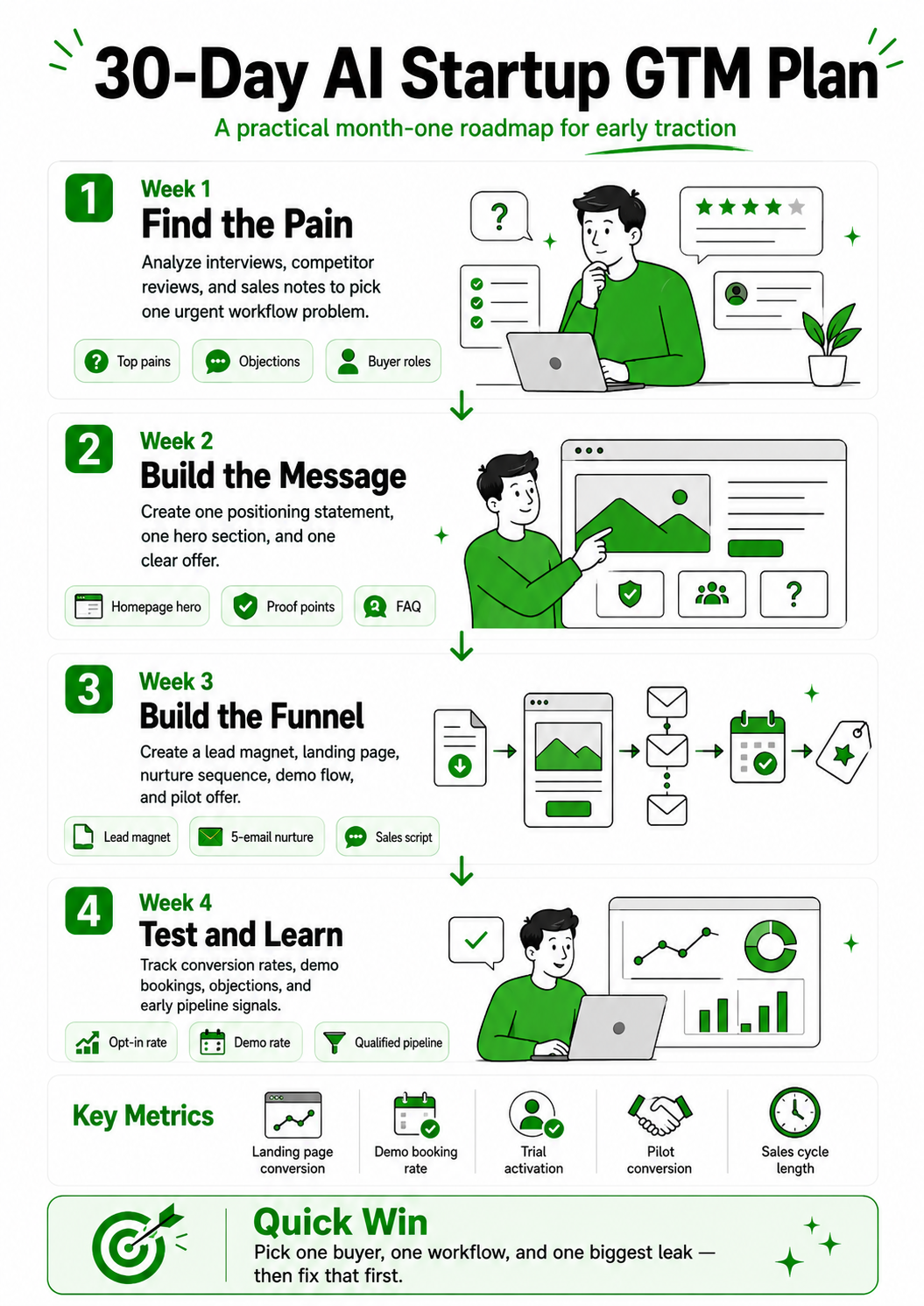
A 30-Day AI Startup GTM Action Plan
Here is the practical version.
No fluff.
No 92-step growth manifesto.
Just the first month.
Week One: Find the Pain
Use AI to analyze:
10–20 customer interviews
Competitor reviews
Sales notes
Community conversations
Support tickets
LinkedIn comments
Output:
Top 5 pains
Top 5 objections
Exact customer phrases
Urgency triggers
Buyer roles
Use case patterns
Pick one beachhead market.
One buyer.
One painful workflow.
Week Two: Build the Message
Create:
One positioning statement
One homepage hero
One landing page
Three value propositions
Five proof points
One simple demo story
One comparison angle
One FAQ section
Test the message through founder LinkedIn posts, outbound emails, calls, and landing page traffic.
Listen for what buyers repeat back.
That is your signal.
Week Three: Build the Funnel
Create:
Lead magnet
Landing page
Thank-you page
5-email nurture sequence
Demo booking flow
Retargeting audience
Sales call script
Objection handling doc
Pilot offer
Use AI to draft.
Use human judgment to edit.
Remember: AI gets you to a first draft.
Taste gets you to something worth publishing.
Week Four: Test and Learn
Track:
Landing page conversion rate
Lead magnet opt-in rate
Demo booking rate
Demo show-up rate
Trial activation
Pilot conversion
Sales cycle length
Objections by stage
Content engagement
Qualified pipeline
Then ask:
Where are people dropping off?
What message gets attention?
Which buyer has urgency?
Which use case creates the fastest “aha” moment?
What proof is missing?
What content should we create next?
Do not try to fix everything.
Find the biggest leak.
Fix that first.
Very Hardy Marketing.
Very effective.
FAQ
What is a go-to-market strategy for an AI startup?
A go-to-market strategy for an AI startup is the plan for reaching the right buyers, explaining the product clearly, generating demand, converting leads, onboarding customers, and proving value. It connects positioning, audience, channels, funnel, sales, content, onboarding, and retention.
How can AI startups use AI for marketing?
AI startups can use AI for customer research, positioning tests, content creation, outbound personalization, sales call analysis, landing page optimization, email follow-up, onboarding, reporting, and funnel testing. The key is to use AI to solve a specific marketing bottleneck, not just create more random content.
What are the best marketing channels for AI startups?
The best channels depend on the buyer, but many AI startups benefit from founder-led LinkedIn, SEO content, outbound email, partner webinars, niche communities, Product Hunt, YouTube demos, paid search, retargeting, and integration marketplaces.
How should an AI startup position itself?
An AI startup should position around a painful customer outcome, not the technology alone. Instead of leading with the AI model or technical architecture, explain the problem solved, who it helps, what changes after using the product, and why the buyer should trust it.
What is AI answer optimization?
AI answer optimization, also called GEO or AEO by some marketers, is the process of making content easier for AI search systems and answer engines to understand, trust, summarize, and cite. It includes clear structure, specific answers, external citations, internal links, original frameworks, expert authorship, FAQs, and schema.
How do AI startups get their first customers?
AI startups often get first customers through founder-led sales, customer interviews, warm networks, niche communities, outbound prospecting, pilot programs, partnerships, demo content, and problem-specific landing pages. The goal is to validate one painful use case before scaling broader marketing.
Should AI startups invest in SEO early?
Yes, but with realistic expectations. SEO usually takes time, but early content helps clarify positioning, answer buyer questions, support sales conversations, and build topical authority. AI startups should focus on specific use cases, comparison pages, FAQs, implementation guides, and problem-aware content.
What is the biggest GTM mistake AI startups make?
The biggest mistake is selling the AI instead of the outcome. Buyers do not usually care about the model, agent, or automation layer first. They care about saving time, reducing cost, increasing revenue, reducing risk, or making a painful workflow easier.
Conclusion
AI startups do not win because they have AI.
That is table stakes now.
They win because they solve a painful problem, explain it clearly, prove value fast, and guide buyers through a journey that makes sense.
That is your go-to-market strategy.
Not a launch post.
Not a feature list.
Not a pile of AI-generated blog articles stacked like digital pancakes.
A real GTM strategy connects:
Audience
Offer
Message
Channel
Funnel
Proof
Follow-up
Sales
Onboarding
Retention
AI can help you move faster across all of it.
It can analyze interviews.
Sharpen positioning.
Draft landing pages.
Personalize outbound.
Summarize sales calls.
Improve onboarding.
Find funnel leaks.
Create better content.
But the fundamentals still matter.
Maybe more than ever.
Because in a world where everyone can create content fast, the winners will be the startups that create clarity.
So start there.
Pick one buyer.
Find one painful workflow.
Build one clear offer.
Create one quick win.
Then use AI to test, learn, and improve faster than the bigger, slower brands lumbering around with corporate oatmeal in their pockets.
That is how AI startups build momentum.
Not by shouting “AI” louder.
By making the buyer’s next step obvious.
Build Your CUSTOM GTM STRATEGY
Need help building a go-to-market strategy that does not sound like every other AI startup wearing a Patagonia vest and yelling “agents”?
Hardy Marketing helps founders and growth teams sharpen positioning, build smarter funnels, improve landing pages, create lead magnets, and design AI-powered customer journeys that turn attention into pipeline.
Start with the buyer.
Fix the friction.
Make the next step painfully obvious.
Book your AI go-to-market strategy today!