AI Marketing Strategy: How an AI Marketer Builds Smarter Funnels
Key Takeaways
AI marketing is not magic. It is speed plus strategy.
A good AI marketer uses AI to improve research, copy, creative, follow-up, testing, and reporting.
The best AI funnels do not just generate leads. They guide buyers through a clear journey.
AI funnel optimization helps you find leaks faster and fix the right bottlenecks first.
An AI Fractional CMO gives small teams senior strategy without hiring a full-time executive.
AI Marketing Is Not About Replacing Marketers. It Is About Removing Friction.
AI marketing has become the shiny new object everyone wants to poke with a stick.
Some people treat it like a vending machine.
Type prompt. Receive money.
Cute idea.
Wrong movie.
Real AI marketing is not “ask ChatGPT for 50 blog ideas and call it a strategy.” That is how you end up with generic SEO sludge that sounds like it was written by a committee of beige office chairs.
Real AI marketing uses artificial intelligence to make the customer journey clearer, faster, and more persuasive.
That means better research.
Better copy.
Better offers.
Better follow-up.
Better testing.
Better reporting.
And yes, fewer funnel leaks bigger than a gas station bathroom faucet.
AI adoption is already shaping how companies market, sell, and operate. Salesforce reports that 63% of marketers are currently using generative AI, which means this is no longer a weird side quest for tech nerds in a coworking space. It is part of modern marketing now. (Salesforce)
But here is where most businesses mess this up:
They use AI to create more stuff.
More posts.
More emails.
More landing pages.
More ads.
More noise.
Then they wonder why conversions do not move.
Because the goal is not more content.
The goal is more clarity.
An experienced AI marketer does not just ask, “How can we publish faster?”
They ask:
Where are buyers confused?
Where are leads dropping off?
What objections are not being answered?
What proof is missing?
What part of the funnel feels like wandering through Whole Foods while starving?
That last one matters.
Because information is cheap now. A 10-year-old can ask AI for a marketing plan. YouTube has tutorials for everything from fixing a sink to launching a SaaS company from a coffee shop.
The brand that wins is not always the brand with the most information.
It is the brand that gives the clearest guidance.
That is the real job of AI marketing.
Not to replace human strategy.
To give the strategist Iron Man armor.
Minus the billionaire trauma and exploding robots.
Google has also been clear that AI-generated content is not automatically bad for SEO. The issue is whether the content is helpful, reliable, accurate, and created for people instead of just manipulating rankings. (Google for Developers)
So no, AI is not the villain.
Bad AI marketing is the villain.
Big difference.
What an AI Marketer Actually Does
An AI marketer is not just someone who knows which buttons to click inside ChatGPT, Claude, Gemini, Jasper, Canva, or whatever tool is trending this week.
That is tool knowledge.
Useful? Sure.
Enough? Absolutely not.
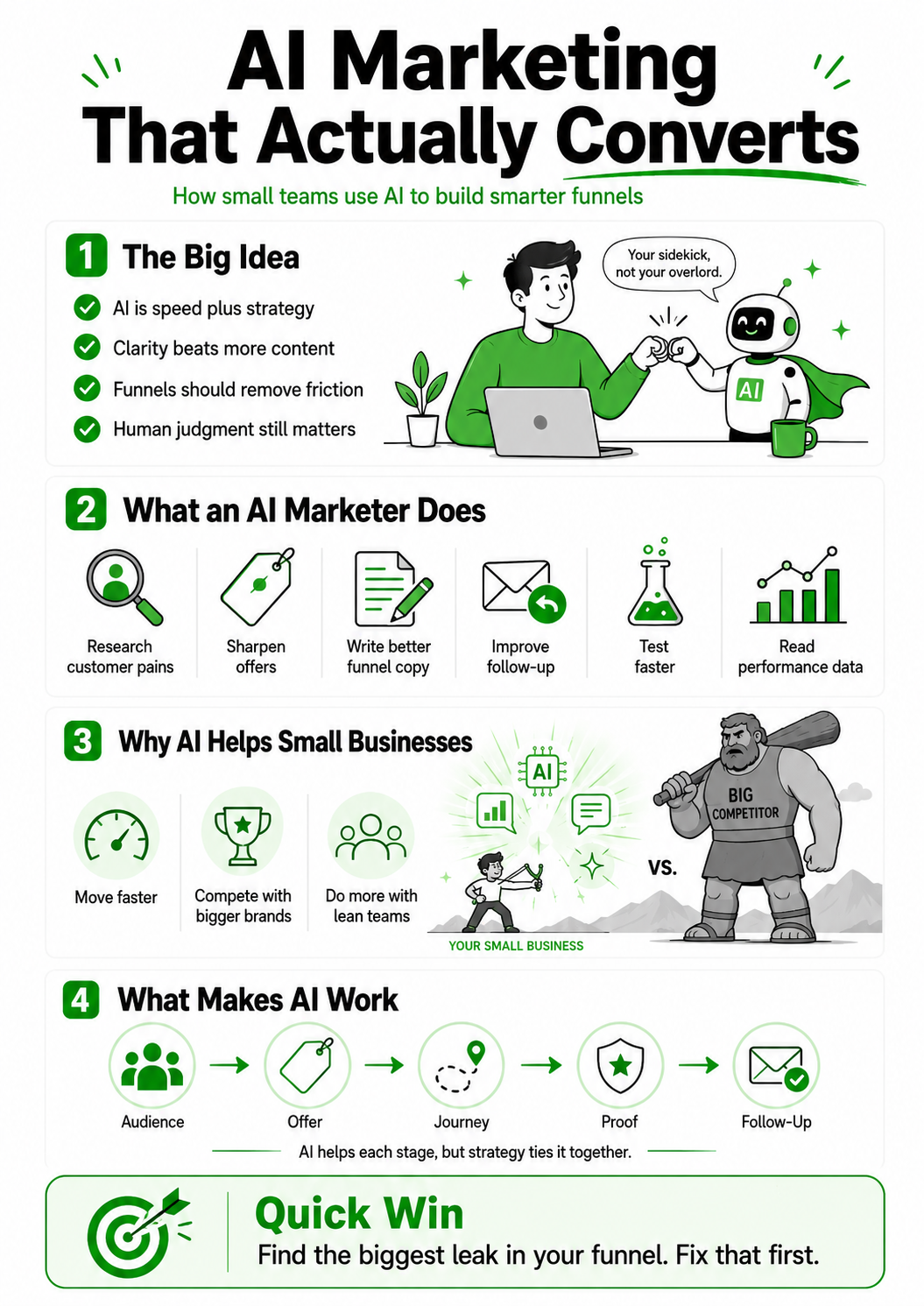
An AI marketer connects AI tools to business outcomes.
That means using AI across the whole customer journey, not just content production.
A strong AI marketer helps with:
Customer research
Offer positioning
Funnel mapping
Ad angles
Landing page copy
Email and SMS follow-up
Lead magnet ideas
Sales page optimization
Retargeting strategy
Reporting and insights
Conversion testing
Content repurposing
Audience segmentation
In plain English?
They help you stop guessing.
They use AI to move faster, then use human judgment to decide what is actually worth doing.
Because AI can generate 100 headlines in 12 seconds.
That does not mean 98 of them are not burnt toast.
The value comes from knowing which ideas fit the audience, the offer, the funnel stage, and the business goal.
For example, let’s say you run a local wellness clinic.
A basic marketer might ask AI:
“Write me a Facebook ad for knee pain.”
An AI marketer with funnel sense asks:
“Analyze these patient reviews, sales call objections, FAQs, and landing page data. Find the top emotional pains, practical objections, urgency triggers, and proof points. Then create ad angles for cold, warm, and hot audiences.”
See the difference?
One prompt creates generic copy.
The other creates strategy fuel.
That is the gap.
And it is a big one.
McKinsey’s 2025 AI research notes that companies are using AI across business functions, including marketing and sales, but the companies getting real value tend to pair AI with strategy, workflow redesign, human oversight, and stronger operating systems. (McKinsey & Company)
That is why “AI marketing” cannot live in the random-tactic junk drawer.
It has to plug into the funnel.
This is also where Hardy Marketing’s AI Marketing Resource Vault becomes useful as a next step. It gives marketers and business owners a place to explore AI marketing tools without diving headfirst into the AI tool black hole and waking up three hours later with 27 tabs open and no new revenue. (Hardy Marketing)
Why Small Businesses Need AI Marketing Now
Small businesses are stuck in a weird spot.
They need better marketing.
But they often do not have the budget for a full creative team, data analyst, copywriter, media buyer, automation specialist, strategist, designer, CRO expert, and caffeinated project manager named Chad.
That is where AI becomes the great equalizer.
AI gives small teams a production team in their pocket.
Research assistant.
Copy assistant.
Creative assistant.
Data assistant.
Strategy sparring partner.
Email drafter.
Content repurposer.
Workflow builder.
Tiny army of digital interns.
Some brilliant.
Some weird.
Some very confident and very wrong.
The point is not to hand your business to the robots and hope they do not make your brand sound like an instruction manual for printer ink.
The point is to help small teams punch above their weight.
A family business cannot always outspend a giant competitor.
But it can move faster.
It can test smarter.
It can create better customer journeys.
It can build more personal follow-up.
It can use AI to find customer language, rewrite confusing offers, generate content ideas, analyze funnel data, and create better sales assets.
That is David with AI infinity stones.
Goliath should be nervous.
Small businesses do not need to chase every new AI tool. They need to pick the right bottleneck and solve that first.
Not the fanciest AI toy.
Not the newest LinkedIn thread.
Not the tool that promises to “revolutionize your brand ecosystem,” which sounds like a sentence created during a hostage negotiation at a SaaS conference.
Start with the real business problem.
For many companies, that problem is the funnel.
And if you want a practical place to explore AI tools for websites, funnels, and landing pages, Hardy Marketing already has resources covering AI website builders and AI funnel builders, including tools like Durable and Framer. (Hardy Marketing)
AI Funnels: Where Strategy Meets Speed
An AI funnel is not just a regular funnel with a chatbot duct-taped to the homepage.
Please do not do that.
An AI funnel uses artificial intelligence to improve the path from first touch to sale.
That path might include:
SEO article
Lead magnet
Landing page
Quiz
Webinar
VSL
Sales page
Email sequence
SMS follow-up
Retargeting ads
Sales call
CRM automation
Customer onboarding
Review request
Referral campaign
The funnel is the full journey.
Not one page.
Not one ad.
Not one “book a call” button hiding at the bottom like it owes somebody money.
A strong AI funnel makes each step easier.
It answers the right question at the right time.
Cold traffic needs clarity.
Warm leads need proof.
Hot prospects need confidence.
Existing customers need guidance.
Past customers need a reason to come back.
That is the game.
AI helps by improving each stage.
For cold traffic, AI can analyze audience pain points and generate better hooks.
For landing pages, AI can help rewrite hero sections, FAQs, objection blocks, and CTA sections.
For lead magnets, AI can help build quick-win resources that attract qualified buyers instead of freebie goblins.
For email follow-up, AI can segment messages based on behavior, interest, objections, or funnel stage.
For reporting, AI can summarize performance and spot patterns faster than a human staring at spreadsheets until their soul leaves the building.
But AI funnels still need a human strategist.
Why?
Because conversion is psychology.
People buy when the next step feels clear, safe, useful, and worth it.
AI can help you get there faster.
But it cannot replace understanding why someone hesitates before booking the call.
That is why the best AI funnels combine:
Human insight
Customer language
Smart positioning
Clear offers
Strong proof
Fast testing
Useful automation
Not just “more AI.”
More AI is not the strategy.
More clarity is.
If someone reading this article wants to compare AI landing page tools, this is a natural internal link opportunity to Hardy Marketing’s AI landing page builder comparison, which covers Durable vs. Framer AI for marketers and business owners building AI-assisted pages. (Hardy Marketing)
AI Funnel Optimization: Fix the Leaks Before Buying More Traffic
Let’s talk about AI funnel optimization, because this is where money stops quietly escaping out the back door.
A lot of businesses try to fix weak sales by buying more traffic.
That can work.
In the same way pouring more water into a leaky bucket technically adds more water.
For three seconds.
Then it leaks out again.
If your funnel is confusing, more traffic just helps more people get confused faster.
AI funnel optimization helps you diagnose the leaks.
Not emotionally.
Not with “I just feel like the page needs more pop.”
With data, patterns, and customer behavior.
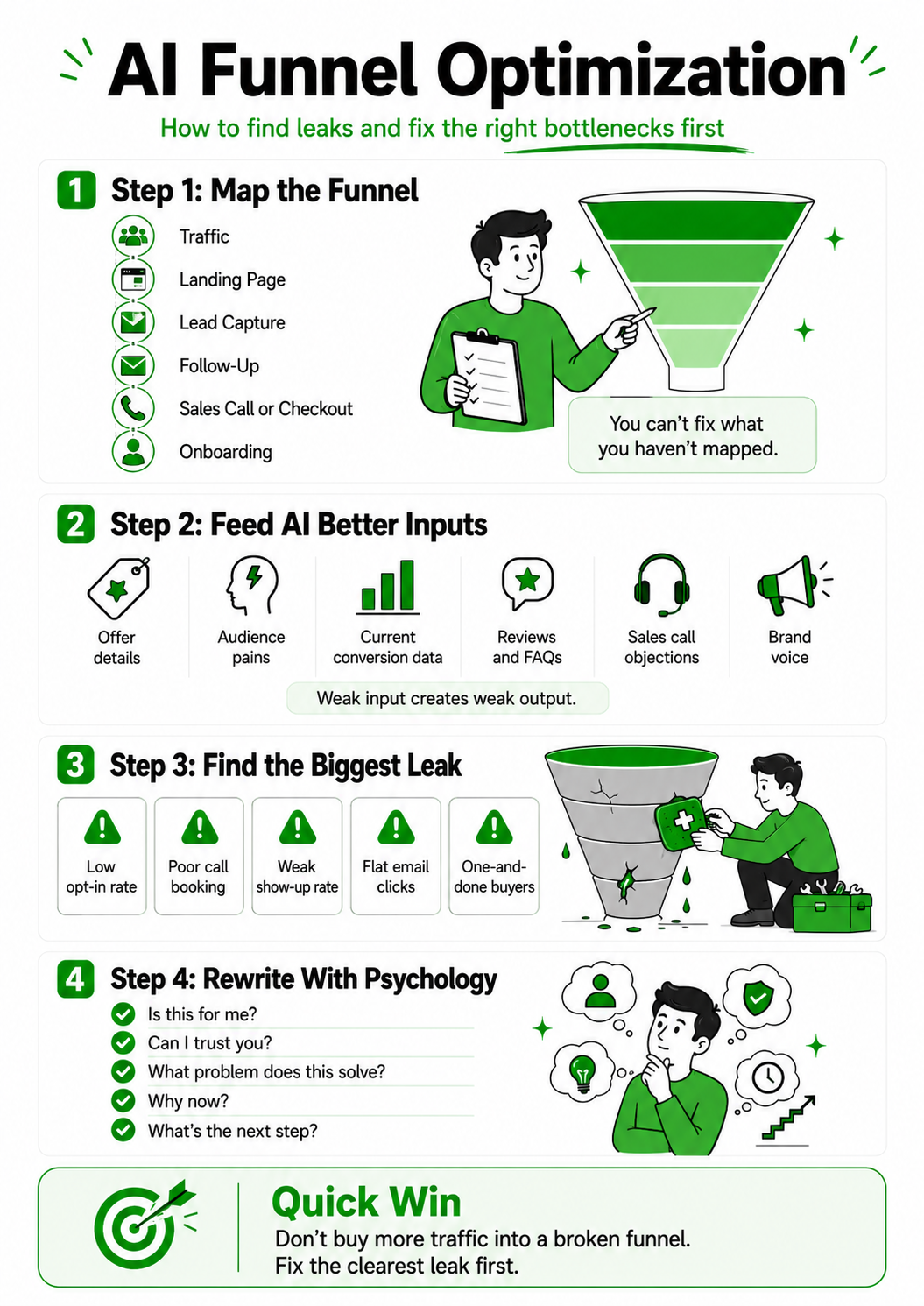
Here is a practical AI funnel optimization process.
Map the Funnel
Start by writing out each step:
Traffic source
First page
Lead capture point
Thank-you page
Follow-up sequence
Sales page or call booking page
Sales process
Close or purchase
Onboarding
Retention or referral
Then ask:
Where are people dropping off?
Where are they hesitating?
Where are they asking the same questions?
Where are they clicking but not converting?
Where are leads going cold?
That map alone can reveal why the funnel feels like IKEA furniture instructions after three margaritas.
Feed AI the Right Inputs
Bad AI output usually starts with bad input.
If you ask AI to “improve my funnel,” it will probably give you a motivational poster with bullet points.
Instead, give it real context:
Your offer
Your audience
Price point
Funnel stage
Current conversion rates
Top objections
Customer reviews
Sales call notes
Landing page copy
Email copy
Ad copy
Competitor examples
Desired action
Brand voice
What not to say
Treat AI like a smart coworker on day one.
Helpful, fast, eager.
But dangerously lacking context.
Google’s documentation on using generative AI for web content also emphasizes accuracy, quality, and relevance, including metadata, structured data, and image alt text. That matters because AI-assisted content still needs human quality control before it goes live. (Google for Developers)
Find the Biggest Revenue Leak
Do not optimize everything at once.
That is how good ideas go to die in a Notion board.
Pick one bottleneck.
Examples:
Landing page traffic is high, but opt-ins are low.
Leads are coming in, but sales calls are not booked.
Calls are booked, but show-up rate is weak.
People open emails, but nobody clicks.
Buyers purchase once, then vanish.
SEO traffic is growing, but conversion is flat.
Each problem needs a different fix.
AI helps you generate hypotheses faster.
But you still need to test like a grown-up.
Rewrite With Buyer Psychology
A strong funnel usually needs better answers to these questions:
Is this for me?
Do I trust you?
What problem does this solve?
Why now?
What makes this different?
What happens if I do nothing?
What is the next step?
Is this going to be painful, expensive, confusing, or risky?
Most landing pages skip these because they are too busy saying things like “custom solutions for modern brands.”
That sentence has never convinced a human to do anything except yawn aggressively.
Use AI to rewrite sections around actual buyer questions.
But keep the human editor in charge.
Because simple beats fancy.
Proof beats hype.
Specific beats generic.
Every time.
Where an AI Fractional CMO Fits In
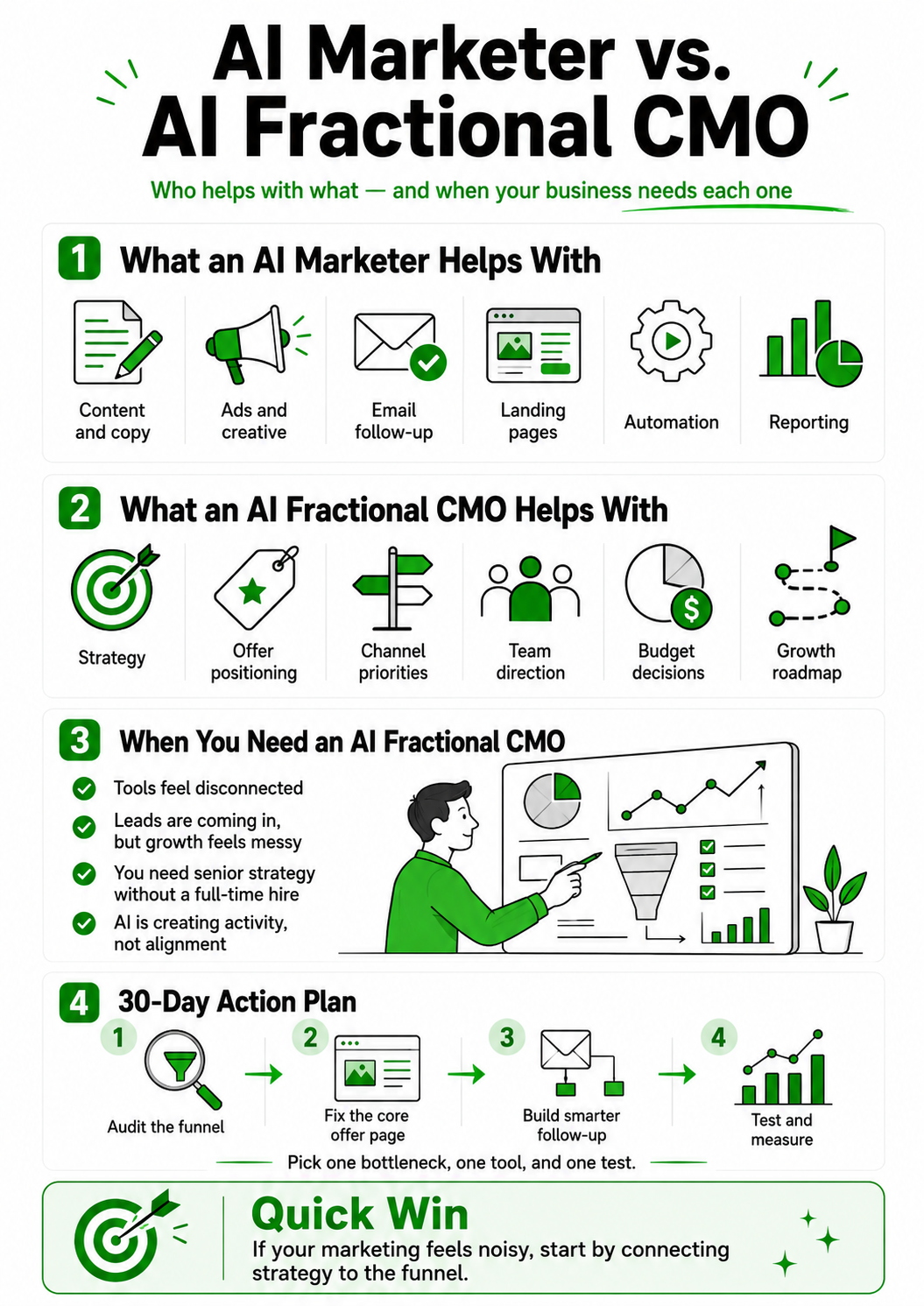
An AI Fractional CMO is useful when a business needs senior marketing leadership, but not a full-time executive.
That is a lot of growing companies.
They have ads running.
Emails going out.
A website that technically exists.
Some social content.
Maybe a CRM.
Maybe a funnel.
Maybe fourteen disconnected tools held together by hope, Zapier, and one exhausted ops person.
What they do not have is a clear strategy.
An AI Fractional CMO helps connect the pieces.
They look at the whole revenue journey and ask:
Who are we targeting?
What is the offer?
What is the message?
Where does traffic come from?
What happens after someone clicks?
What is the follow-up?
What are we measuring?
What should we stop doing?
What should AI automate, improve, or speed up?
What still needs a human touch?
This is important because AI can make a messy business louder.
Not better.
If your offer is unclear, AI can help you create unclear content faster.
If your funnel is broken, AI can help you scale the broken parts.
If your audience targeting is sloppy, AI can help you annoy the wrong people at enterprise speed.
Congratulations.
You built a robot-powered confusion cannon.
An AI Fractional CMO prevents that.
They build the strategy layer.
They help decide which systems matter, what should be automated, what should be personalized, and what should be tested first.
For small businesses, agencies, consultants, clinics, coaching companies, SaaS teams, and local service brands, that can be the sweet spot.
You get senior-level thinking without adding a full-time CMO salary.
You get AI implementation without chasing the AI tool black hole.
You get someone focused on revenue, not random activity.
That is the difference between “we are using AI” and “AI is actually helping us grow.”
This fits naturally with Hardy Marketing’s positioning around lead generation, customer journeys, and turning customers into raving fans — not just creating random marketing assets for the sake of activity. (Hardy Marketing)
The Hardy Marketing AI Funnel Framework
Here is a simple framework for building better AI funnels.
Nothing fancy.
No 37-step funnel wizard spell.
Just the core pieces that matter.
Audience
Start with the buyer.
Not the tool.
Not the channel.
Not the campaign idea you saw on LinkedIn at 11:43 p.m. while eating cereal over the sink.
Who is the customer?
What do they want?
What are they afraid of?
What have they already tried?
What do they misunderstand?
What words do they use?
The best funnel copy comes from the customer’s exact language.
Reviews.
Sales calls.
Support tickets.
Comments.
FAQs.
DMs.
Objections.
That is the good stuff.
AI can help analyze it, sort it, summarize it, and turn it into messaging themes.
But you need to collect the raw material.
Offer
Next, make the offer clear.
A weak offer cannot be saved by AI glitter.
Your offer should answer:
What do they get?
What problem does it solve?
How fast can they see value?
Why should they believe you?
What makes it easier or safer to say yes?
What happens next?
If your offer sounds vague, your funnel will wobble.
People do not buy confusion.
They buy outcomes.
Journey
Map the journey by awareness stage.
Cold buyers need education.
Problem-aware buyers need clarity.
Solution-aware buyers need comparison.
Ready buyers need proof and a clear next step.
Do not send everyone the same message.
That is like giving every restaurant customer a dessert menu before they sit down.
Timing matters.
Proof
AI can help write copy.
Proof helps people believe it.
Use:
Testimonials
Case studies
Before-and-after examples
Screenshots
Numbers
Reviews
Client stories
Process breakdowns
Demonstrations
People trust evidence.
Not vibes.
Not vague claims.
Not “we are passionate about helping brands succeed.”
Great.
So is everyone else with a Canva account.
Show the proof.
Follow-Up
Most buyers do not convert on the first touch.
This is where many businesses quietly lose money.
They get the lead.
Then send one sad email.
Then nothing.
That is not follow-up.
That is marketing ghosting.
AI can help build smarter follow-up based on behavior.
Downloaded the checklist?
Send next-step education.
Visited the pricing page?
Send proof and objection handling.
Booked a call?
Send prep material and trust-builders.
Did not show?
Send a rebooking sequence.
Bought once?
Send onboarding, usage tips, review requests, and referral prompts.
The money is often in the follow-up.
Not because you are “selling harder.”
Because you are guiding better.
Common AI Marketing Mistakes That Kill Results
Let’s make this painfully practical.
Here is where people mess this up.
They Start With Tools Instead of Problems
This is the AI tool black hole.
You watch one video.
Then another.
Then suddenly you have 19 tabs open, three free trials, a headache, and zero new revenue.
Better move:
Pick one problem.
One tool.
One test.
Example:
“Our leads are not booking calls after downloading the guide.”
Good.
Use AI to analyze the guide, thank-you page, email sequence, and call booking page.
Fix that.
Then move on.
They Use AI Without Brand Voice
This is how your company starts sounding like every other business that “empowers growth through innovative solutions.”
Please no.
Give AI examples of your voice.
Tell it what to avoid.
Use simple words.
Add customer phrases.
Add stories.
Add personality.
Then edit.
AI is the sidekick.
Not the overlord.
They Create Content With No Next Step
SEO traffic is nice.
But traffic without a conversion path is digital confetti.
Every article should help the reader move forward.
That could be:
Download a checklist
Book a funnel audit
Read a related article
Watch a training
Compare services
Join a newsletter
Start a diagnostic quiz
Do not leave people stranded.
Guide them.
They Ignore the Middle of the Funnel
Everyone loves top-of-funnel content.
It feels productive.
But many buyers need middle-funnel assets before they are ready.
Examples:
Comparison guides
Case studies
“How it works” pages
Objection-handling articles
ROI calculators
Funnel teardown videos
Email nurture sequences
This is where trust gets built.
Skipping it is like asking someone to marry you after one coffee.
Bold.
Usually bad.
They Automate Before They Understand
Automation makes good systems faster.
It makes bad systems dangerous.
Before automating, ask:
Does this message help?
Is this segmentation useful?
Does the timing make sense?
Are we sending people the right next step?
Is the data clean enough?
AI plus messy data equals spicy chaos.
Fun to watch.
Terrible to manage.
How to Measure AI Marketing and Funnel Success
If you cannot measure it, you are guessing.
And guessing is expensive.
Not every AI marketing win shows up as immediate revenue, but the best systems should improve something measurable.
Track:
Organic traffic
Keyword rankings
Click-through rate
Landing page conversion rate
Cost per lead
Cost per booked call
Sales call show-up rate
Lead quality
Email open rate
Email click rate
Sales conversion rate
Customer acquisition cost
Revenue per lead
Time saved
Content production speed
Follow-up completion
Retention
Referrals
For AI funnel optimization, focus on movement through the funnel.
A simple example:
Before optimization:
1,000 visitors
80 leads
10 booked calls
6 show-ups
1 sale
After optimization:
1,000 visitors
120 leads
22 booked calls
16 show-ups
4 sales
Same traffic.
Better journey.
More revenue.
That is the point.
AI should not just make marketing busier.
It should make the path clearer.
And the numbers should show it.
McKinsey has also reported that organizations are seeing some of the strongest revenue benefits from AI use in marketing and sales, which is exactly why AI belongs in the revenue conversation — not just the “make me more content” conversation. (McKinsey & Company)
In other words, boring content is not just boring anymore.
It is a conversion tax.
Possibly a visibility tax too.
That is rude.
Avoid it.
Practical AI Marketing Plan for a Small Business
Here is a simple 30-day plan.
No fluff.
No “build a fully autonomous omnichannel revenue engine.”
We are not summoning a marketing dragon.
We are fixing what matters.
Week One: Audit the Funnel
Map the customer journey.
Collect:
Website pages
Landing pages
Ads
Emails
Lead magnets
Sales call notes
Reviews
FAQs
Analytics
CRM stages
Ask AI to summarize friction points, repeated objections, unclear messaging, and missing proof.
Then verify with human judgment.
Because AI can help spot patterns, but it does not know your business like you do.
Week Two: Fix the Main Offer Page
Pick one core page.
Homepage.
Service page.
Landing page.
Booking page.
Rewrite:
Hero section
Who it is for
Problem section
Solution section
Proof section
Offer breakdown
FAQ
CTA
Make it clearer.
Make it more specific.
Make the next step obvious.
If your CTA is hiding like a raccoon in a dumpster, bring it into the light.
Week Three: Build Smarter Follow-Up
Create email and SMS sequences for key actions:
New lead
Booked call
No-show
Proposal sent
New customer
Past customer
Use AI to draft.
Use human editing to make it sound real.
Add proof.
Add stories.
Add useful tips.
Add next steps.
Do not just “circle back.”
Nobody likes being circled back on.
It sounds like a hawk attack.
Week Four: Test and Measure
Pick two or three tests.
Examples:
New headline
New lead magnet
New call booking page
New nurture sequence
New retargeting angle
New FAQ section
New proof block
New CTA
Measure before and after.
Do not change 19 things and then pretend you know what worked.
That is not testing.
That is marketing soup.
Suggested Internal Links for Hardy Marketing
Use these as internal link opportunities when publishing:
Link AI marketing tools to Hardy Marketing’s AI Marketing Resource Vault. (Hardy Marketing)
Link AI website builders or AI funnel builders to Hardy Marketing’s article on AI website and funnel builders. (Hardy Marketing)
Link AI landing page builders to Hardy Marketing’s Durable vs. Framer AI comparison. (Hardy Marketing)
Link customer journey optimization, marketing funnels, or lead generation strategy to the Hardy Marketing homepage or relevant service page.
Link book a funnel audit or AI-powered funnel system to your main contact or booking page.
FAQ
What is AI marketing?
AI marketing is the use of artificial intelligence to improve marketing research, content, ads, emails, funnels, analytics, personalization, and automation. The goal is not to replace strategy. The goal is to help marketers move faster, test smarter, and create clearer customer journeys.
What does an AI marketer do?
An AI marketer uses AI tools to improve marketing outcomes. That can include customer research, copywriting, funnel optimization, ad testing, SEO planning, email automation, reporting, segmentation, and content repurposing. A good AI marketer connects tools to revenue instead of just creating more content.
What is an AI Fractional CMO?
An AI Fractional CMO is a part-time senior marketing leader who uses AI, automation, funnel strategy, and data to help a business grow. This role is useful for companies that need strategic leadership but do not need or cannot yet justify a full-time CMO.
What are AI funnels?
AI funnels are marketing and sales funnels improved with artificial intelligence. AI can help with audience research, messaging, landing pages, lead magnets, email sequences, personalization, retargeting, and analytics. The best AI funnels still depend on strong offers, proof, customer psychology, and clear next steps.
What is AI funnel optimization?
AI funnel optimization is the process of using AI to find and fix weak points in a marketing funnel. This might include improving landing page copy, segmenting leads, rewriting follow-up emails, analyzing drop-off points, testing CTAs, or finding objections that are stopping people from buying.
Can AI marketing help small businesses?
Yes. AI marketing can help small businesses compete with bigger brands by speeding up research, content creation, follow-up, testing, and reporting. But the best results come when AI is paired with strategy, customer insight, and strong marketing fundamentals.
Is AI marketing bad for brand voice?
It can be if you use lazy prompts and publish raw AI output. That is how brands end up sounding like corporate oatmeal. To protect brand voice, feed AI strong examples, give clear instructions, use simple language, include customer phrases, and always edit with a human eye.
Should I hire an AI marketer or an AI Fractional CMO?
Hire an AI marketer if you need hands-on help with campaigns, funnels, content, automation, or optimization. Consider an AI Fractional CMO if you need higher-level strategy, leadership, prioritization, and a clear plan for using AI across your marketing system.
Conclusion
AI marketing is not about replacing humans.
It is about helping smart humans move faster.
An AI marketer can help you research faster, write faster, test faster, and spot funnel leaks before they quietly drain your budget like a subscription you forgot to cancel in 2021.
But the fundamentals still matter.
Your offer still matters.
Your customer journey still matters.
Your proof still matters.
Your follow-up still matters.
AI just gives you more speed, more insight, and more creative firepower.
Used badly, it creates more noise.
Used well, it helps small teams compete with bigger brands, build better AI funnels, and turn confused prospects into confident buyers.
So start simple.
Find the biggest leak in your funnel.
Fix that first.
Then use AI to make the next step clearer, safer, and easier for your customer.
That beats chasing 47 shiny tools you will never use.
And it definitely beats publishing another blog post that sounds like a dry tofu sandwich wearing a name tag.
BUILD A BETTER MARKETING FUNNEL
Need help finding the biggest leak in your funnel?
Hardy Marketing helps small businesses, agencies, and founders build smarter AI-powered funnels, improve lead magnets, sharpen landing pages, and create follow-up systems that actually move people toward the sale.
Start with the journey.
Fix the friction.
Make the next step obvious.
Book your funnel marketing call today.